Denis Noble
https://iai.tv/video/consciousness-is-biologys-biggest-blunder
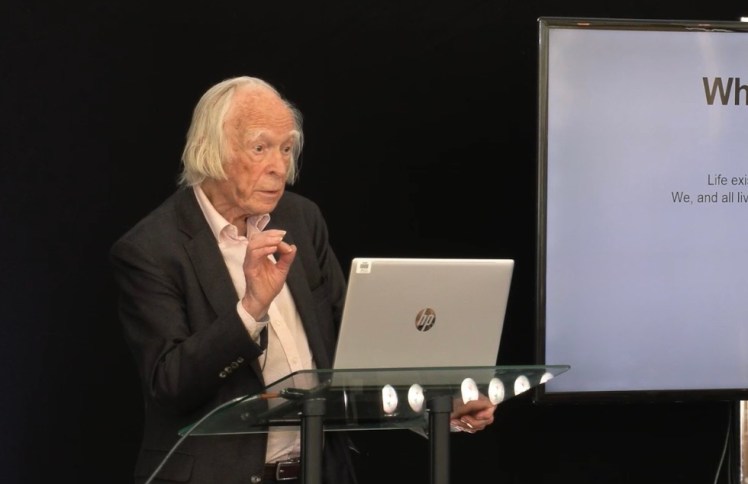
I was interested to see a video on IAI in which Denis Noble, replacing another speaker, argues that the established view makes similar mistakes about both DNA and consciousness.
Unfortunately you need a subscription to see the video, but I’ll try to give the gist very briefly. On DNA Noble’s main target is what he calls the central dogma, that DNA replication is an automatic, chemical process. This is more or less the Richard Dawkins view that it all comes down to ‘naked replicators’, self replicating molecules. Noble says automatic self replication simply isn’t good enough: the process has to be controlled by the cell. This means in turn that mutation is also under a controlled process. He accepts, in fact insists, that random change is an essential part of this controlled process, and he claims that besides the changes caused by radiation, copious randomness arising from the Brownian motion of water molecules is indispensable.
On consciousness he invokes Gerald Edelman, whose theory of ‘neural Darwinism’ drew an analogy between the immune system and consciousness. In Edelman’s theory, the brain does not solve problems by computation. Just as the immune system throws random molecules at a threat until it literally finds ones that stick, the mind throws neural patterns at its inputs and reinforces the ones that happen to work.
I’ve always thought Edelman had an interesting argument, though I couldn’t follow some of his points. Noble approves of the anti-computational view and further argues that the powerful randomisation of water is essential to consciousness as it is to DNA replication and mutation. He regrets that Edelman called it ‘Darwinism’.
I’m not au fair with the latest state of evolutionary biology, but I think in that respect Noble’s claims are less revolutionary than he implies. It is well known that in The Selfish Gene Richard Dawkins simplified things rather a lot – I think he himself acknowledged that much – and the picture has grown steadily more complex over the years since. But the essential idea of random change acted on by survival of the fittest is as robust as ever, and in fact isn’t Noble kind of advocating it?
The interesting task is clarifying those extra complications, specifying how the process is controlled in a way that makes it more efficient than simple self-replication of DNA – or ideas – could ever be. I feel we have still not heard enough about that so far as consciousness is concerned, but it was nice to see Edelman getting an acknowledgment.

