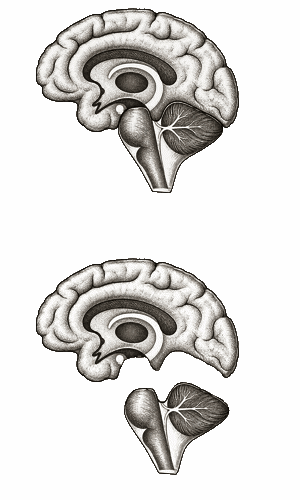
It’s hardly news that the hindbrain (brain stem and cerebellum) is distinct from the mid- and fore-brain, and carries out different functions. But researchers at Stamford have shown that they have different cell lineages, and have in effect been two distinct organs for at least 550 million years.
Why is that surprising? Well, they carry out rather similar tasks. When we learn to do some new physical thing like walking or driving we have to use the conscious parts of our brain, which seem to be in the forebrain, especially the cortex. We think about what we are doing. But once the process is learnt consciously, control passes to the cerebellum, part of the hindbrain, which carries out the same task fairly intelligently but without us needing to think about the detailed movements. I’ve read that people can survive after the cerebellum has been completely removed, but life is difficult because they have to pay real attention to every step. Our hindbrain runs our heartbeat without letting us have conscious control, but while it also controls breathing, it tolerates conscious intervention in that process, up to a point.
If the two parts of the brain carry out similar tasks, handing them back and forth like this, we might expect they do it similarly. They both have neurons, though in the cerebellum they are smaller and more tightly packed. Now it appears that instead of growing as part of a single process, the have radically different cellular progenitors. Must we assume that this is a case of convergent evolution, with neurons evolving twice, but in adjacent places? That seems a little bizarre.
The main takeaway is surely that the evolution of the brain was stranger and more complex than we thought, but it also brings into focus the question: where are we? Is the seat of our conscious personhood in the forebrain, or in the hindbrain which enjoys greater prominence in creatures with less complex behaviour than ours? At first sight it seems obvious that we live in the cortex. It’s the newest part of the brain, and it’s clearly the bit that does the talking, and the thinking that, we may presume, informs the talking. Everything that is distinctive about human consciousness seems to happen in the cortex.
But is basic consciousness unique to humans? I doubt it. Some sort of essential agency is surely present even in animals without a cortex – which is basically anything other than a mammal. Birds and reptiles might be able to use the telencephalon they do have, and fish and invertebrates might use some other neural structure, but really the cortex looks like the icing on the cake, important for the fancy stuff but not the real substance. It is impossible, of course, to conduct any real experiments on this, and thought experiments don’t really cut it, though for what it’s worth I think I can imagine myself without thoughts or sophisticated perceptions, but still sort of existing.
Perhaps it’s a bad question in the first place and our consciousness is present in both brains? Nobody said it had to exist in a single neuron, after all, and some have said that even the whole brain is not enough. But that’s where the new research makes it a little more difficult. If the two brains are closely allied but also pretty different it might tip us towards accepting two different styles of consciousness working closely together. Wasn’t there some theory about a subconscious? But then, wasn’t there also some research about the different hemispheres of the brain? How many consciousnesses do we want in one head?


Perhaps the cortex is akin to a turbo-charger for the hind brain. It’s apparently what allowed animals having one to have taken over the planet.
LikeLike